

Quick Look
-
Temperament:
-
Egg Color:
-
Egg Production:
-
Cold Hardy:
-
Heat Tolerance:
-
Broodiness:
-
Purpose:
Alert, Active, & Independent
Brown to Deep Terracotta Brown
Moderate
Moderate
Excellent
Occasional
Egg Production - Leaning Dual Purpose
Why We Raise Crele Penedesencas
We raise Crele Penedesenca for their dark terracotta-brown eggs, exceptional heat tolerance, and strong foraging ability. This is a breed that excels in warmer climates and active environments, making it a practical choice for keepers who value performance as much as tradition.
In addition to their functional strengths, Crele Penedesenca are a rare standard breed whose continued future depends on thoughtful stewardship. Maintaining healthy, productive lines requires intentional breeding decisions and responsible placement rather than volume production.
We are especially drawn to the auto-sexing varieties, which allow for early sex identification and more intentional planning. This supports clearer expectations for buyers while contributing to long-term stability and preservation of the breed.
Living With Crele Penedesenvas
Crele Penedesencas are active, alert birds with strong foraging instincts. They tend to be more independent than heavier or more docile breeds and are best suited to environments where they have space to move and opportunities to forage.
Because of their Mediterranean background, they are efficient, agile, and observant. With regular handling they can be manageable, but they are not typically considered a “pet-style” breed. Their temperament is well-matched to keepers who appreciate birds that are self-directed and capable rather than sedentary.
Penedesencas thrive in flocks where birds are expected to work—covering ground, seeking food, and adapting to seasonal conditions—rather than remaining confined or highly managed.
Climate & Seasonal Performance
Crele Penedesencas are exceptionally heat tolerant and perform well in hot, dry, and humid conditions. Their active nature and strong foraging ability allow them to stay productive through summer when heavier breeds may struggle.
Cold tolerance is more limited. Both roosters and hens have large, upright combs, which can make them susceptible to frostbite during prolonged cold or wet winter conditions. In colder climates, winter management and housing design play a larger role in maintaining comfort and health.
Seasonal shifts in laying and fertility are normal, particularly as daylight length and temperatures change.
Is This Breed a Good Fit for You?
Crele Penedesencas are a strong fit for keepers who value dark egg color, heat tolerance, and active foraging behavior. They do best in environments where birds have space to move and are expected to be engaged rather than confined or highly managed.
This breed is well suited for those who appreciate alert, self-directed chickens and are comfortable with a more independent temperament. Keepers who enjoy watching birds work the land and adapt to their environment often find Penedesencas especially rewarding.
They may not be the best choice if you are looking for a very cold-hardy breed, a quiet or docile flock, or birds that thrive in tight confinement. Crele Penedesencas are best appreciated when their natural strengths are allowed to shine.

Stewardship & Breeding Work
For those interested in a deeper look at this variety at Cross B Hens & Heifers, Crele Penedesencas are a breed we maintain with intention as part of a broader, balanced program. Our focus is on flock health, consistency, and preserving the functional traits that define the breed, rather than intensive refinement or large-scale production.
A Brief History of the Breed Variety
The Penedesenca is a historic Spanish breed originating in the Catalonia region of Spain. It developed as a practical farm bird, valued for its ability to produce dark brown eggs while thriving in warm, dry climates.
One of the breed’s most distinctive physical traits is the king’s comb, also known as the carnation comb. This large, upright comb is a hallmark of the breed and helps set Penedesencas apart from other Mediterranean chickens.
For much of its history, the breed remained regional, shaped by local conditions rather than large-scale commercial production. This helped preserve its distinctive traits—strong foraging ability, heat tolerance, and rich egg color—but also limited its spread beyond its place of origin.
Like many regional European breeds, the Penedesenca declined as industrial poultry production expanded. Modern Crele Penedesenca populations exist today because of dedicated breeders who have worked to preserve both the breed’s functional qualities and its historic characteristics.

Our Program, Progress, and Direction
Our Crele Penedesenca program at Cross B focuses on preserving the breed while improving clarity of type and consistency over time. The flock was developed from multiple sources, providing enough genetic variation to support thoughtful selection and long-term progress.
The birds have proven to be productive, fertile, and reliable layers of dark terracotta-brown eggs, giving us a solid foundation to build from. As the program has matured, we have become more deliberate in refining both color and overall breed characteristics.
Our current direction prioritizes a clearer crele appearance, moving away from diluted cream coloration while still evaluating each bird as a whole. Progress is measured over generations, with the goal of strengthening consistency without narrowing the breed’s usefulness or resilience.

A Closed Flock and Intentional Selection
Our Crele Penedesenca flock is managed as a closed flock, allowing us to better protect flock health and track progress across generations. Working within a known population makes it possible to evaluate outcomes more clearly and make informed decisions rather than reactive changes.
Intentional selection guides every breeding decision. Birds are evaluated on overall function and breed character, with attention to egg color, fertility, structure, and clarity of type. No single trait is selected in isolation; progress depends on balancing multiple characteristics while maintaining resilience within the flock.
Because this is a rare breed, selection is approached conservatively. Improvements are made gradually, with an emphasis on stability and long-term viability rather than rapid change.
Balancing the Full Package
Crele Penedesencas are not difficult to raise, but they can be challenging to refine. Bringing together the full combination of traits—correct crele color, proper ear lobe color, a well-defined king’s (carnation) comb, and a consistently large, dark terracotta-brown egg—takes time and careful selection.
It is common for individual birds to excel in some areas while falling short in others. One bird may have excellent egg color but weaker comb definition, while another may show strong type but lighter eggs. Progress comes from evaluating the whole bird, rather than selecting too narrowly on any single trait.
Our focus is on building birds that balance function, appearance, and productivity, understanding that consistency improves over generations rather than in a single hatch.

Ongoing Evaluation and Future Work
Our work with Crele Penedesenca is ongoing and evaluated over time rather than by individual hatches. Each season provides new information that helps guide pairing decisions and long-term direction.
Current areas of focus include improving consistency in crele coloration, refining ear lobe clarity, maintaining a well-defined king’s (carnation) comb, and continuing to strengthen egg size and depth of color. No single trait is prioritized at the expense of the others; progress depends on balancing the full package.
As the program moves forward, decisions remain guided by function, stability, and long-term breed integrity. Availability reflects what the flock can responsibly support as this work continues.
Why We Emphasize Hatching Eggs & Chicks
Raising birds beyond early stages requires time, space, and daily labor, and those resources are essential to maintaining an active breeding program. As birds mature, they are no longer simply being grown out — they are being observed and evaluated as part of the program. Space used to hold older birds is space that could otherwise support future breeder candidates.
Once birds reach the point where sex and pattern are clear, selection decisions begin. Some birds are identified early, while others are held longer to better understand how they develop. If a bird ultimately does not align with the direction of the program, it is absorbed into our own flock rather than offered for sale in an effort to recoup some cost.
Because of this structure, we are not set up to raise pullets or adult birds for others. For those hoping to work with our birds, hatching eggs and fresh-hatched chicks offer the most realistic opportunity. This allows the program to remain focused, sustainable, and centered on the breed itself rather than volume or turnover.

A 2025 Crele Penedesenca
Cockerel showing the right
down color at hatch.
Following the Program’s Progress
As the program continues to develop, we share updates, photos, and seasonal progress through our social channels. This allows those who are interested to follow the evolution of the flock over time and see how long-term selection translates into visible improvement.
Pricing & Availability
Please review all information below before placing your order. By ordering, you agree to the terms outlined.
Hatching Eggs
Hatching Egg Information
Crele Penedesenca – 2026 Season
Local Pickup: $80 per dozen
Shipped: $116 per dozen
Quantities are limited and may vary weekly based on laying consistency.
Eggs are marked with breeding pen and collection date for buyer reference. As a courtesy, one additional egg is included for every five eggs purchased.
Our Crele Penedesenca breeding program is focused on strengthening:
• Correct King’s (Carnation) comb structure and consistency
• Clear, well-defined Crele patterning
• Progressive darkening and uniformity of egg color
While significant progress has been made, variation may still occur as this line continues to be strengthened and stabilized.
Egg Handling & Collection
Eggs are collected within a 3-day window, stored on egg turners at room temperature, and candled prior to shipment to ensure structural integrity before packing.
Orders are fulfilled in the order received. Most orders ship within 7–14 days; however, depending on laying consistency and breeding program demands, fulfillment may take up to 4 weeks.
Shipping & Pickup
Shipping is included in the listed price for up to one dozen eggs per order. Orders are packed using foam shipping systems and sent via USPS Priority Mail.
We ship to states that allow NPIP-certified poultry and hatching eggs.
AI Clean certification update expected April 2026.
Local pickup is available by appointment. You will be contacted when your order is ready to schedule pickup.
Important – Please Read Before Ordering
Due to the fragile nature of hatching eggs and variables involved in shipping and incubation:
Shipping Damage
If eggs arrive damaged, clear photos and video of the packaging and contents must be provided on the day of delivery, including the exterior box, interior packaging, and all damaged eggs. Once documentation is received, we will review and work toward an appropriate resolution.
Hatch Rates
We do not guarantee hatch rates. Hatch success is influenced by postal handling, incubation practices, equipment accuracy, and environmental conditions beyond our control.
By placing an order, you acknowledge and agree to these terms.

Chicks

Straight Run Chicks
• $15 each (0–2 weeks)
• $20 each (3–4 weeks)
• Pricing reflects the 2026 season
Straight run chicks are offered directly from the hatch and reflect the natural outcome of that specific hatch. Choosing straight run means your order will be filled from what hatches in that batch, without selection for sex.
For example, if you order 15 straight run chicks and the hatch produces more pullets than cockerels, you will receive that natural ratio. If the hatch produces more cockerels than pullets, the same applies. Straight run pricing reflects this shared risk and reward and is handled as fairly as possible based on hatch results.
Pullet Chicks (Auto-sexing)
• $22 each (0–2 weeks)
• $32 each (3–4 weeks)
• Pricing reflects the 2026 season
Because Crele Penedesenca are available in auto-sexing varieties, we are able to offer guaranteed pullets in limited numbers. Pullet availability depends on hatch outcomes and is more limited than straight run offerings.
Chicks are offered in limited, seasonal batches. Availability varies by hatch.
Requests from specific breeding pens may be accommodated in limited situations.
All chicks hatched on the farm are wing-banded at hatch for identification and tracking.
Availability announcements are sent by email when ordering windows open.
Juveniles & Adult Birds
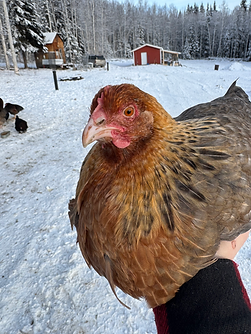
One of Our Ladies in Alaska
Opportunities to purchase juveniles or adult birds are limited and not routinely available. When offered, placement and pricing are handled individually based on age, development, and program considerations.
Availability notifications, when applicable, are shared by email.